Community Voices
International District Choice Neighborhood
Urban Planning + Community Engagement
The International District Choice Neighborhood Plan seeks to create a forward-looking plan focused on people, housing, and neighborhood. This Plan is focused on redeveloping existing distressed public housing in three different sites into mixed-income developments while identifying additional investments for the International District neighborhood.
In September 2023, the City of Albuquerque and the Albuquerque Housing Authority (AHA) were awarded a U.S. Department of Housing and Urban Development (HUD) Choice Neighborhoods Planning Grant for the International District neighborhood. Spanning approximately 2,000 acres on the east side of the city, the International District is known for its cultural diversity. Home to nearly 28,000 residents, the area has a young and highly diverse population, with 74% identifying as people of color, 21% being foreign-born, and 25% under the age of 18. The district grew during the 1960s and became recognized as a predominantly immigrant community.
The Plan focuses on the redevelopment of AHA’s low-income housing, which consists of 98 units across three properties: Wainwright Manor (60 units), Grove (18 units), and Pennsylvania (20 units). All 98 units will be fully replaced as part of the redevelopment effort.
Borderless Studio was selected as the planning coordinator for this two-year process and assembled a team that includes Collabo Planning—a practice specializing in neighborhood revitalization—and the University of New Mexico’s Design and Planning Assistance Center. In this role, Borderless Studio oversees community engagement, develops analyses, strategies, and projects for the Plan’s various elements, and implements early action activities to support the planning process.
Approach
People, Housing, Neighborhood
The Plan identifies strategies for People (education, health, safety, income and employment), Housing (typologies, quality, affordability), and Neighborhood (Open Space, Transportation, Services and Amenities, Culture, and Sense of Belonging). With this framework, the goal of the Choice Neighborhoods Initiative is to have a comprehensive approach to public housing redevelopment that includes both the physical conditions of housing and improving the quality of life of residents.
Process
Working with community
This planning process centers work with residents and community stakeholders—nonprofits, faith-based organizations, services agencies, businesses, and more—to create a forward-looking plan focused on people, housing, and neighborhood. Through community engagement activities, including meetings, working group sessions, and workshops, the planning team brings as many perspectives and insights as possible to shape the plan strategies and projects.
Building a safe, connected and thriving neighborhood
The Neighborhood Plan promotes a safe, vibrant, and culturally rooted community. It improves mobility, walkability, and access to essential services like food and health. Strategies support unhoused residents, expand park and fresh food access, and strengthen local identity, helping create a more resilient and connected community.
Expanding affordable housing and stability
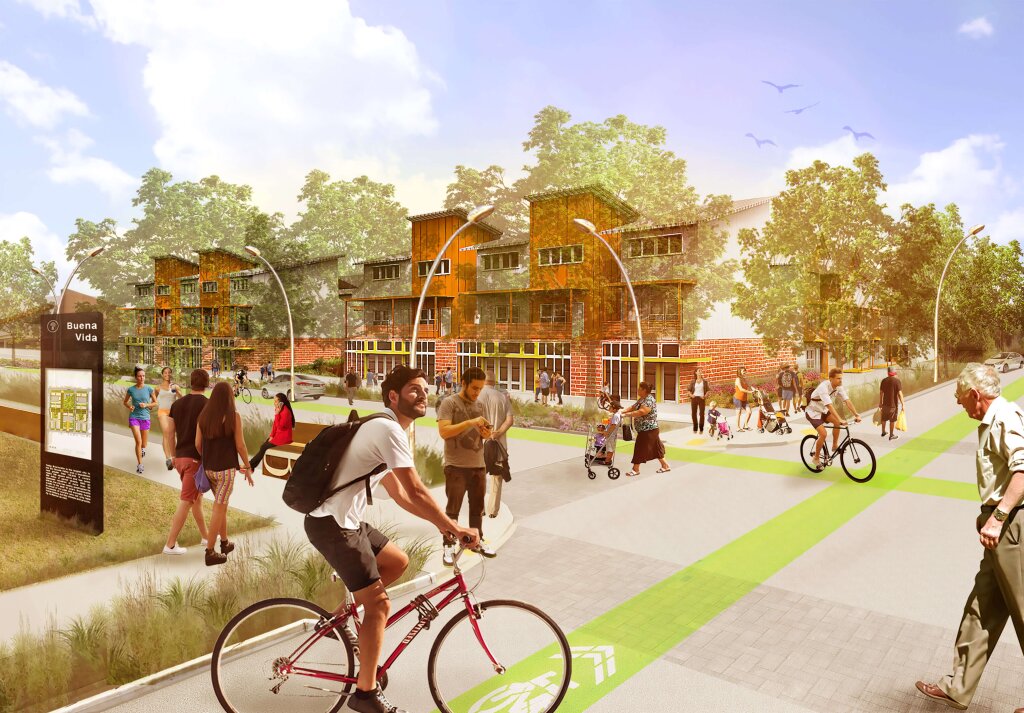
The Housing Plan integrates new and existing housing to support community growth and long-term stability. It prioritizes redevelopment of two key sites: Wainwright Manor and Grove Apartments, as well as the development of two additional sites. The plan aims to expand affordable options through infill and homeownership support, and strengthens coordination among partners while increasing shelters, supportive housing, and policy tools for unhoused residents.

Proposed redevelopment - Wainwright Manor site. Architectural Design: Hartman + Majewski Design Group

Proposed redevelopment - Grove Apartments site.
Architectural Design: Hartman + Majewski Design Group

Proposed development - Dallas and Southern site.
Architectural Design: Hartman + Majewski Design Group

Proposed development - Phil Chacon site.
Architectural Design: Hartman + Majewski Design Group

Housing Design Workshop - Visioning Exercise